
Discover the Aim-to-Impact lesson planning
The 5-step AIM framework was designed following many years of observing teachers teach.
Our flagship framework, developed by us through Oxford University Masters research, is a proven clear, five-step lesson planning model. Rooted in instructional clarity, AIM embeds theory such as Gradual Release of Responsibility (Fisher & Frey, 2008), scaffolding theory (Vygotsky, 1962) and Blooms Taxonomy (1956) to provide consistent lesson planning practice and evaluations across organisations, leading to measurable impact. AIM has already been applied successfully in academic settings and is proving highly effective in developing the planning skills of new, beginning and experienced teachers alike.
AIM addresses the knowledge gaps which exist when lessons are not effective; a lack of instructional clarity, poor alignment between instructional content and lesson aims, and poor task design.
Step 1 — Foundation: Define your learning aim
What do you want your learners to know, or be able to do, by the end of the lesson?
Step 2 — Connection: Build your learning outcomes
Work out the three steps to achieving your aim, making sure they increase in complexity — these become your learning outcomes. We use Bloom's Taxonomy to build in challenge, and the 'I do, We do, You do' model (Gradual Release of Responsibility, Fisher & Frey, 2008; 2021) to structure the journey towards independence.
Step 3 — Transformation: Design the tasks and activities
Design the instructional method, task or activity that will achieve each outcome, making sure it is neither too difficult nor too easy, with scaffolding and support planned into every task. This step draws on retrieval, scaffolding, chunking, the Zone of Proximal Development and cognitive load.
Step 4 — Contingency: Check and adapt
Plan a whole-class learning check after each stage, and be ready to go back a step to reinforce key concepts if needed.
Step 5 — Contingency: Test your objectives
Use a plenary to test your learning objectives against what has actually been learned, and to assess next steps.
Underpinning it all — Climate
Every stage of the model sits within the classroom climate: relationships, routines and expectations that make effective learning possible.
Join the Adventure
Follow us on social media to get a sneak peek of our upcoming content and be the first to know when we launch!
Teaching Practice Enhancement
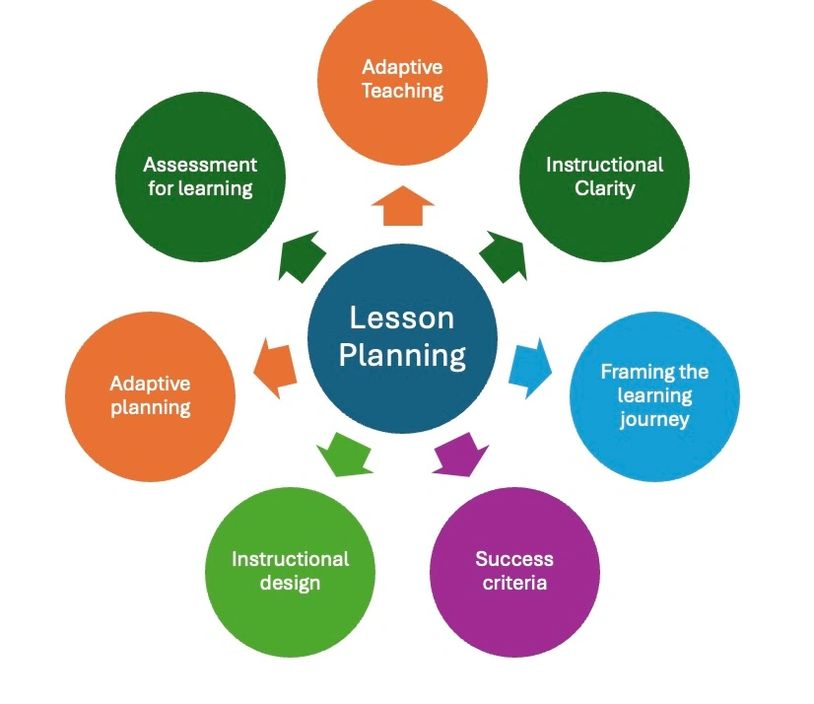
We help teachers sharpen the everyday strategies that make the biggest difference to learning — from how a lesson is adapted in the moment to how progress is checked and behaviour is managed. This work is practical and classroom-facing, and can be delivered through training sessions, coaching or joint planning. Key areas include:
● Adaptive Teaching — responding in the moment to what learners need
● Formative Assessment and Questioning Strategies — checking understanding as you go
● Whole-Class Feedback and Marking Strategies — high-impact feedback that reduces workload
● Behaviour Management Approaches — building calm, purposeful classrooms
Our programmes are entirely bespoke and include an initial consultation, programme design and preparation, bespoke resources, delivery and session evaluation.